Stack Overflow 2026: Almost Everyone Uses AI. Not Everyone Is Better Off.

The 2026 Stack Overflow Developer Survey is out, so I extended last year's dashboard to compare U.S. developers in both years side by side. The biggest changes turned out to be in pay and job satisfaction...
The short version:
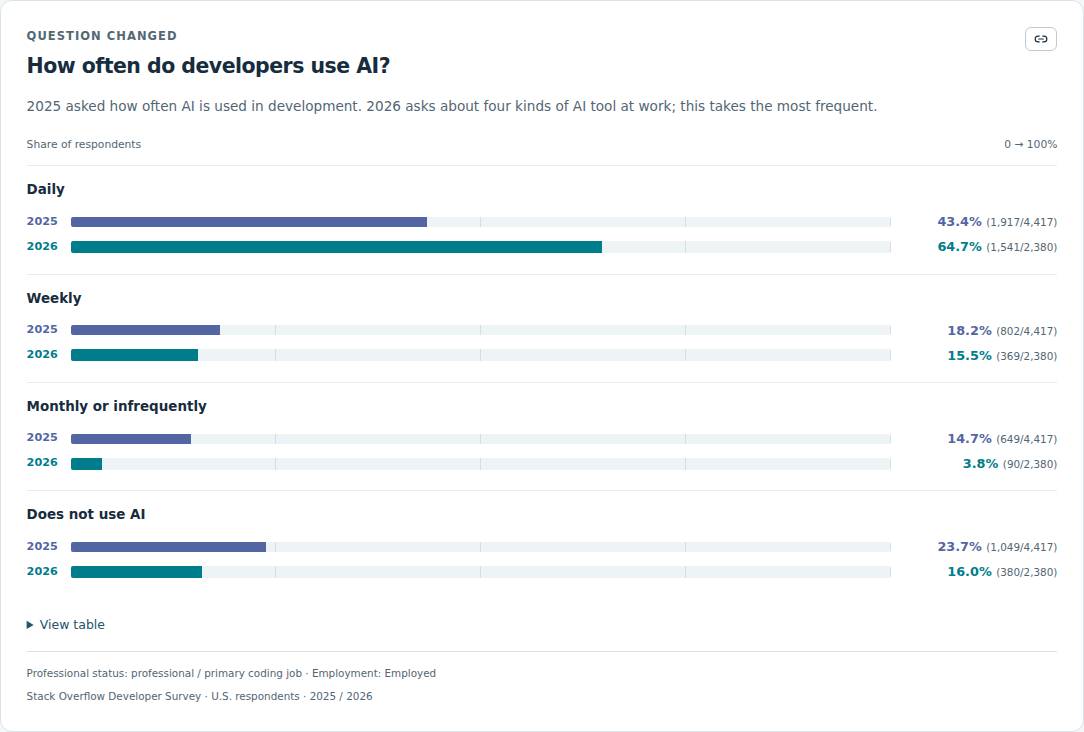
- AI is the default. 65% of developers use it every day, up from 43%.
- The AI pay gap more than doubled. Daily AI users out-earn people who don't use AI by $41k, up from $17k.
- More developers are unhappy at work. One in three, up from one in four.
- Measuring AI use goes with unhappy developers. Where companies measure AI use as part of performance, half of developers are unhappy, vs. a quarter where AI is optional.
- More daily AI users dislike it. Among developers who use AI every day, 17% have an unfavorable view of it, up from 5%.
- The good news: AI users say it got much better at complex tasks. 58% rate it positively, up from 31%.
Open the 2026 vs 2025 dashboard →
I'm looking at U.S.-based, employed developers. About 40% fewer of them answered this year. Stack Overflow also rewrote most of its AI questions. The data notes cover how I handled that.
AI is the default now
Two thirds of developers (65%) now use AI every day, up from 43%. The 2026 question is broader and counts chat tools too, but even coding tools alone are used daily by more than half. Only 16% don't use AI at all, down from 24%.
Claude Code is the most-used coding tool, whereas in the previous survey only 1 in 8 developers had used it (it had come out a few months prior). Now, let's talk about money.
The AI pay gap more than doubled
Median pay for daily AI users went up, from $162k to $171k. For people who don't use AI, it went down, from $145k to $130k. That's a $41k gap, up from $17k.
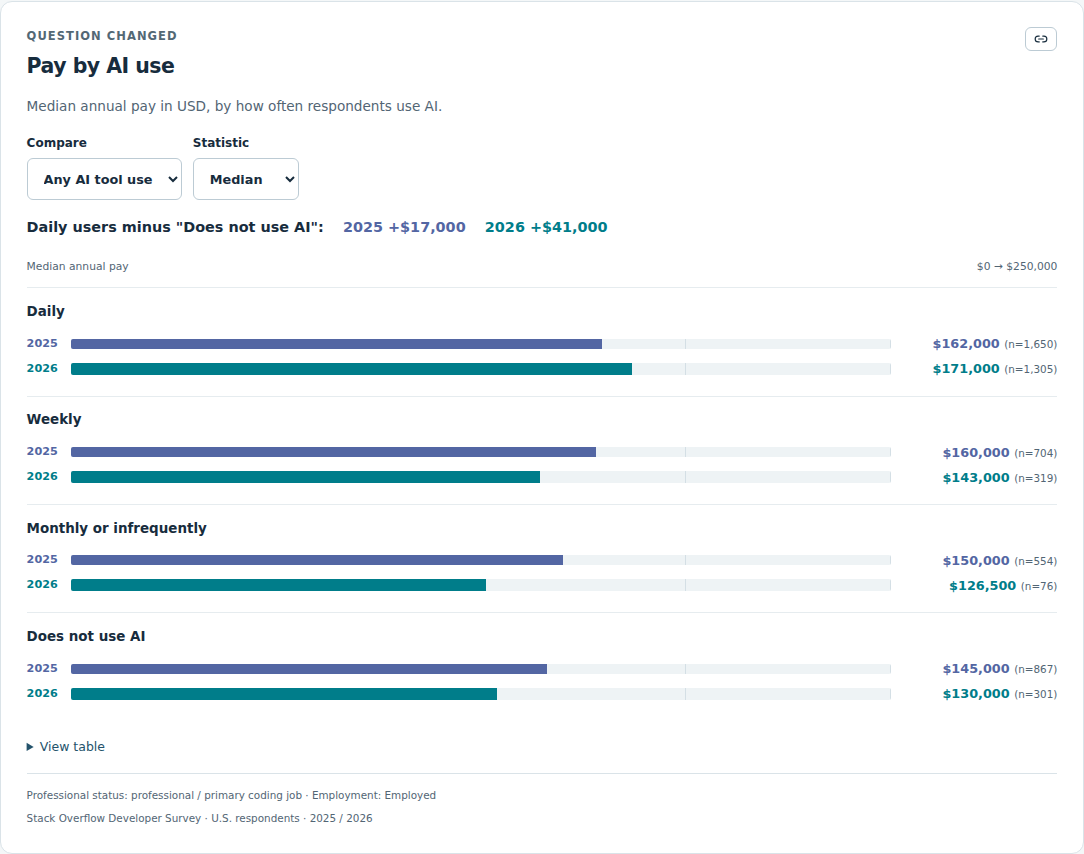
In 2025, how often you used AI barely showed up in your paycheck. In 2026, daily users pulled well ahead of everyone else. Meanwhile the overall median didn't move at all: $155k both years.
A few things worth knowing:
- It's not just seniority. Comparing like for like (similar experience, role, company size, and industry), daily users earned 7% more than non-users in 2025 and 24% more in 2026.
- It's biggest for agents. Daily users of AI agents and automated workflows report $190k, $60k more than people who don't use AI.
- It grew most at small companies. Under 500 employees, the gap tripled, from $15k to $46.5k.
Did AI give anyone a raise? I can't tell you that. These are different people each year, and the groups themselves changed. The people who still don't use AI are a smaller, more particular bunch: nearly half avoid it for moral or ethical reasons, and they're almost twice as likely to work in government.
Part of that gap is about where people work. Companies that push AI also tend to pay more, and more of their developers use AI every day. Add the company's AI policy to the like-for-like comparison, and that 24% shrinks to 16%. So it could be that AI makes you more valuable, or simply that the best-paying employers adopted AI first. Probably both.
More developers are unhappy at work
Developers rate their job satisfaction from 0 to 10, and Stack Overflow groups the answers into happy (9–10), complacent (7–8, fine but not thrilled), and unhappy (0–6). The share of unhappy developers went from 25% to 32%, or from one in four to one in three.
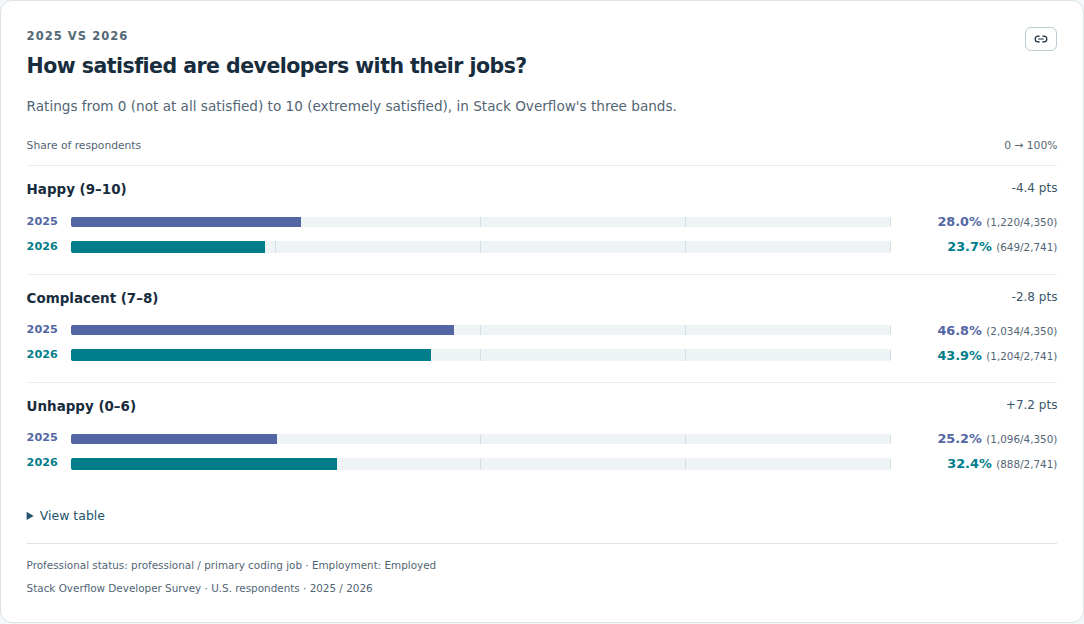
It's tempting to blame AI, but unhappiness rose just as much among people who don't use AI, and at every company size, from the smallest to the largest.
What made jobs harder? The top answers were unclear priorities, inefficient processes, leadership changes, and not enough time or staff. Not exactly a list of AI complaints.
But there is one place where AI and unhappiness line up very neatly.
Where AI use is measured, half are unhappy
New in 2026: the survey asks how each developer's company treats AI. About 1 in 7 say their company measures AI use as part of performance. The more a company expects AI use, the more of its developers are unhappy: about a quarter where AI is optional, comes with approved tools, or is encouraged by some teams; 38% where it's expected for certain work; and 51% where it's measured.
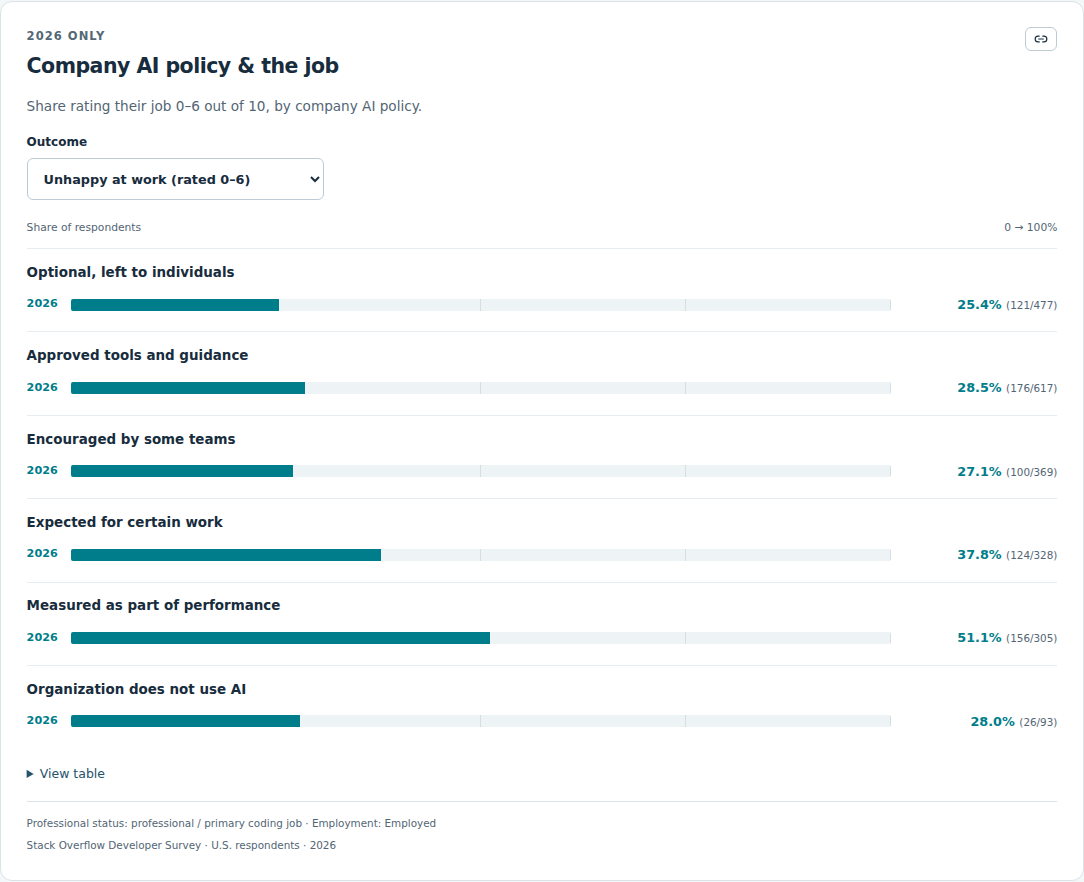
The measured group is also the best paid, at a median of $186k vs. $128k where AI is optional. Highest pay, lowest satisfaction... And comparing people with similar experience, pay, company size, and views on AI, it's still about half unhappy vs. a quarter.
So who's unhappy there? Pretty much everyone, but not equally:
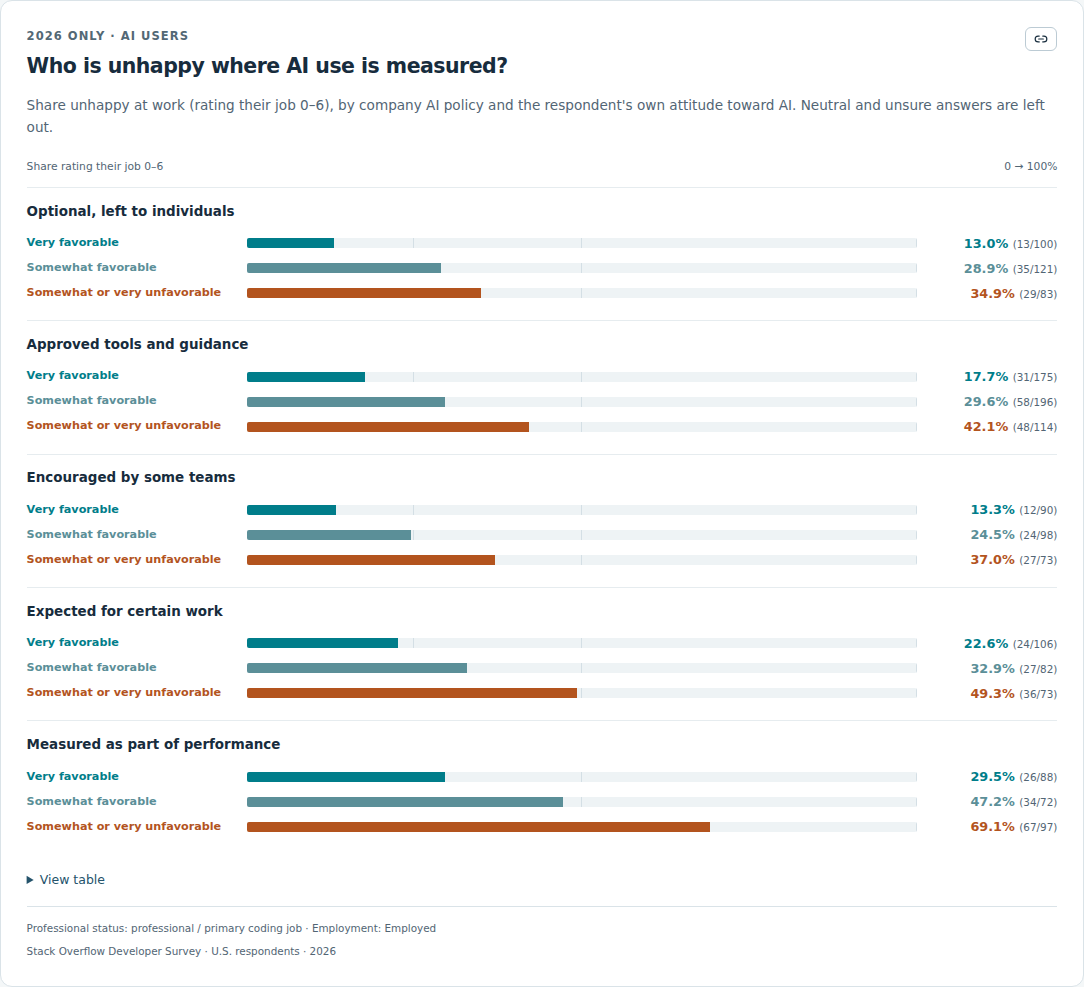
Where AI use is measured, 7 in 10 developers who dislike AI are unhappy, twice the rate where AI is optional. For developers who somewhat like AI, it's 47% vs. 29%. Even the biggest AI fans aren't immune: 30% vs. 13%. Loving AI softens the blow. It doesn't cancel it.
This isn't just a Stack Overflow thing. In Atlassian's 2026 developer experience report, 41% of developers admit they sometimes use AI more than necessary because they feel expected to.
A few big companies made it official. In mid-2025, Microsoft's developer division told managers that using AI is "no longer optional". Meta made "AI-driven impact" a core expectation in its 2026 reviews, then told engineers in September, after the survey closed, that it "will not use AI adoption dashboards or token counts to evaluate impact."
The caveats: unhappy people may describe their company's policy more harshly, and companies that measure AI use may also be the ones reorganizing. I checked the second one. Leaving out everyone whose biggest problem was leadership or reorganization, the gap barely changes.
More people use AI daily without liking it
Among AI users, 62% view AI favorably, down from 68%.
The clearest change is among daily users:
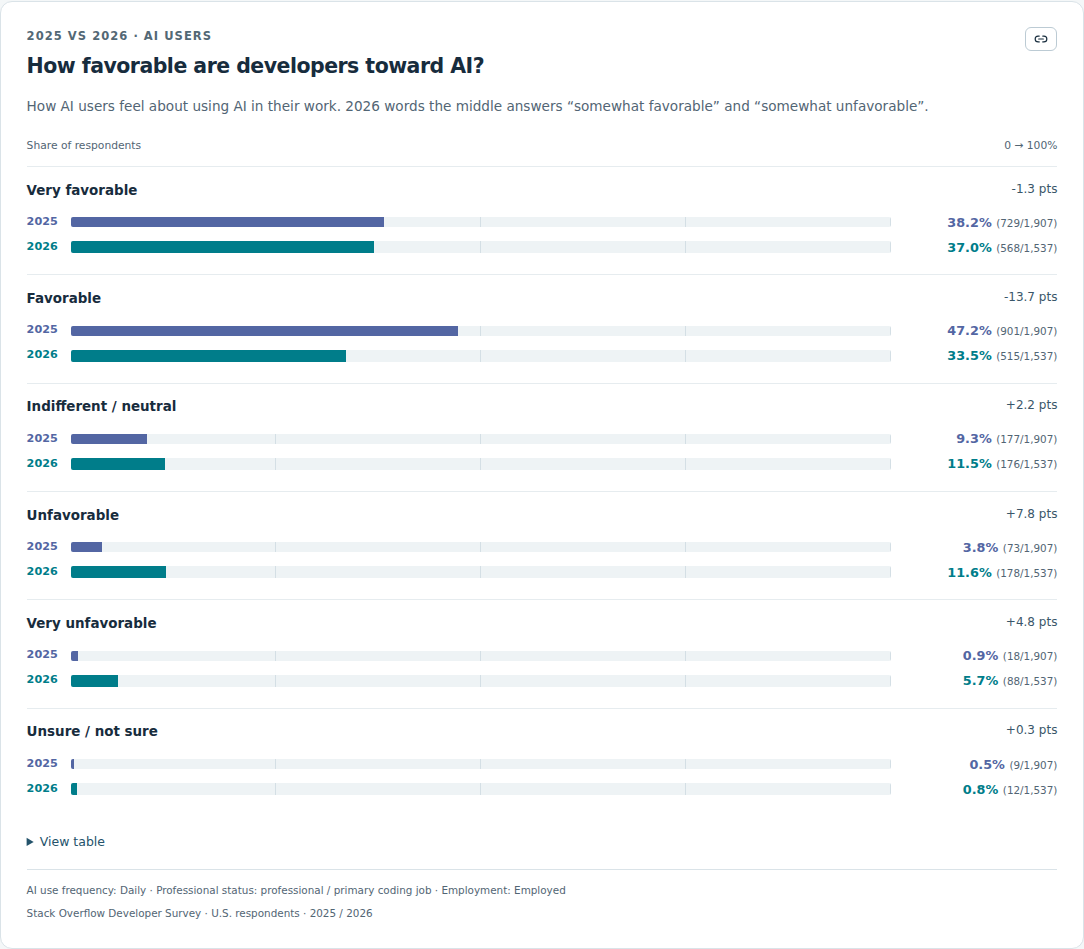
Among people who use AI every day, the share who dislike it went from 5% to 17%, while "very favorable" barely moved (38% to 37%). Stack Overflow reworded some answers this year, but even "very unfavorable", whose wording didn't change, went from 1% to 6%.
In 2025, using AI every day meant you probably liked it. Now about one in six daily users doesn't. Where AI use is measured, it's one in four. But it isn't only mandates: plenty of daily users dislike AI where it's optional too.
The good news: users say AI got better at the hard stuff
Among AI users, positive ratings of AI on complex tasks went from 31% to 58%.
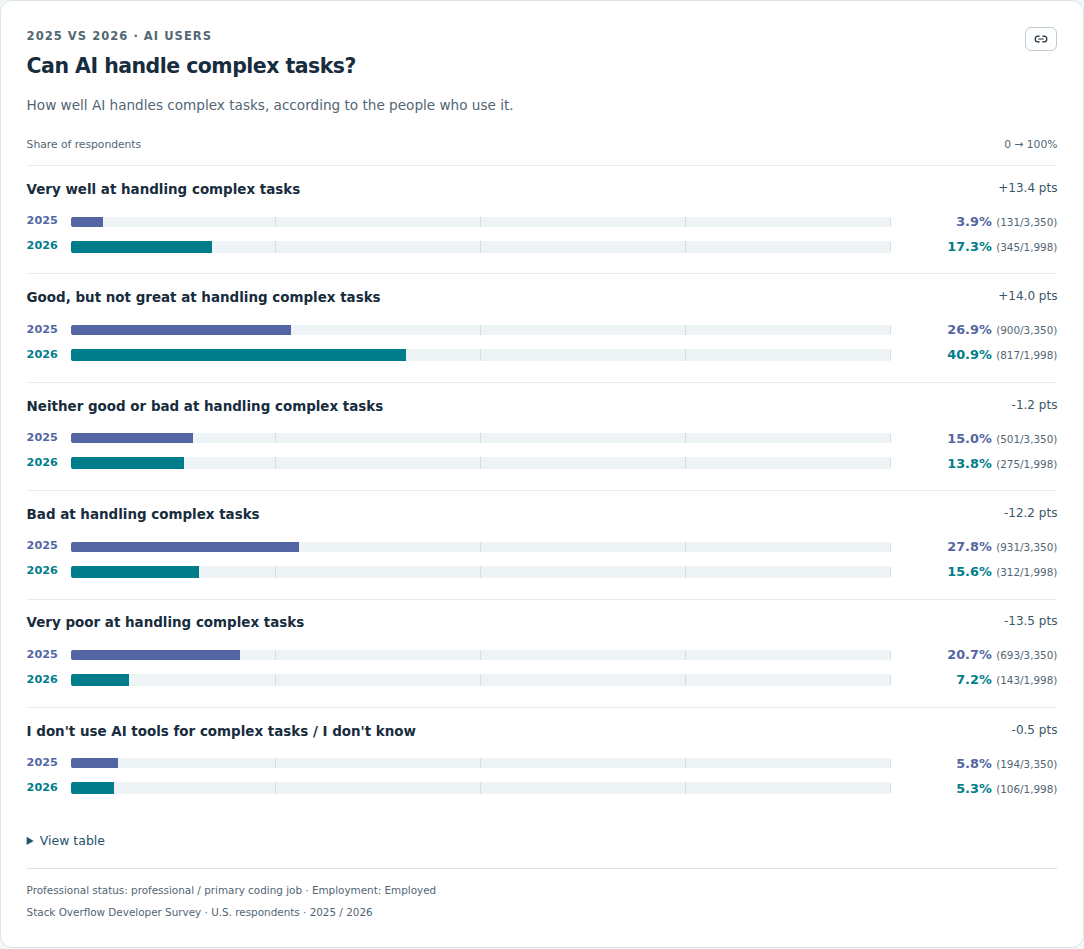
Part of that is just more daily users, who rate AI higher. But even accounting for that, most of the jump remains.
AI didn't make every task more enjoyable, though. 69% of AI users say it made debugging and refactoring more satisfying, and 11% less. For implementation, it's 57% more and 23% less. Communication is the exception: 25% say AI made it less satisfying, and only 23% more. Some of that comes from people who don't even use AI for it, perhaps from being on the receiving end of AI-written messages.
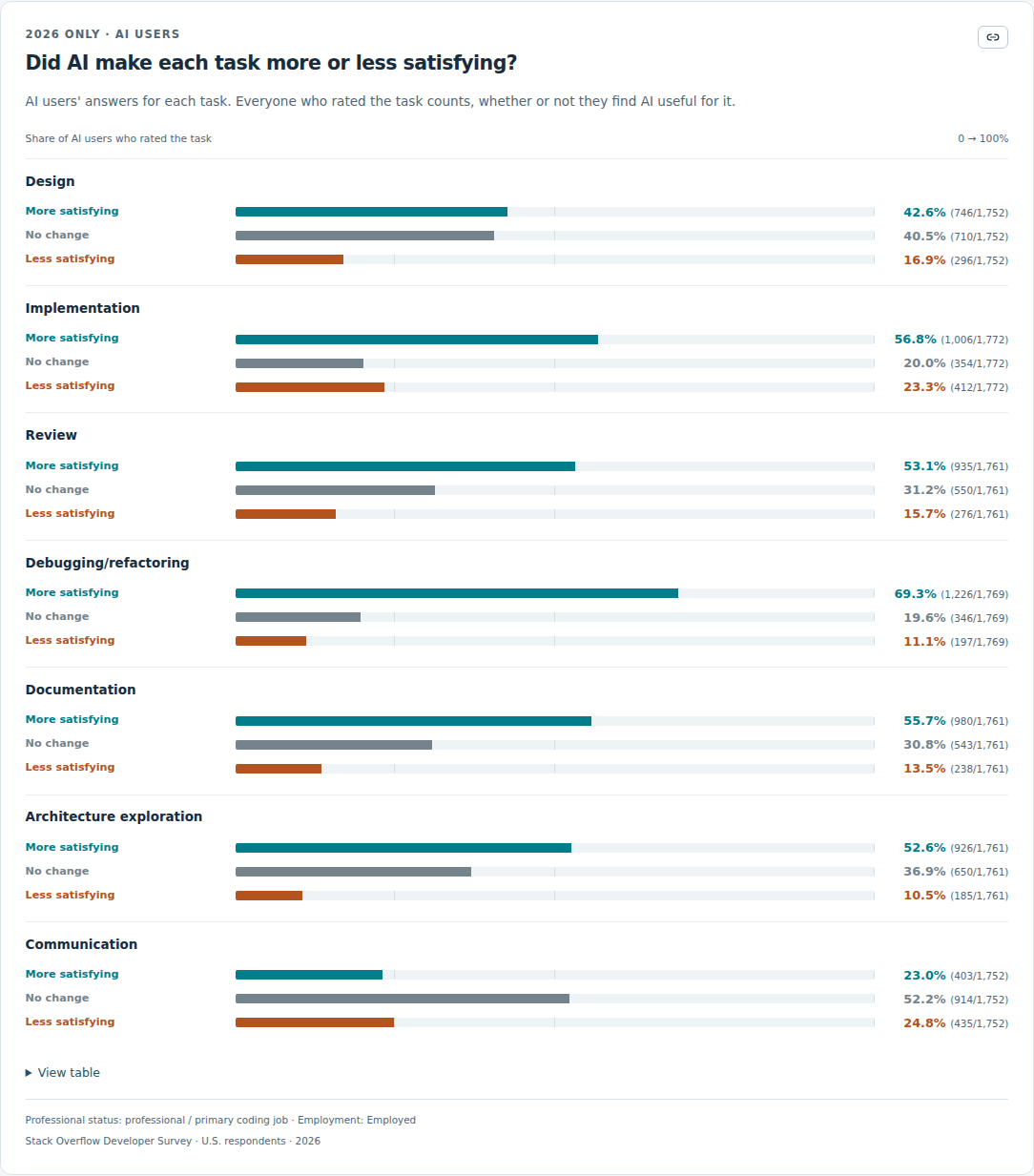
And it isn't only people AI doesn't help. Even among developers who find AI useful for implementation, 18% say it made the work less satisfying. For debugging and refactoring, it's 6%.
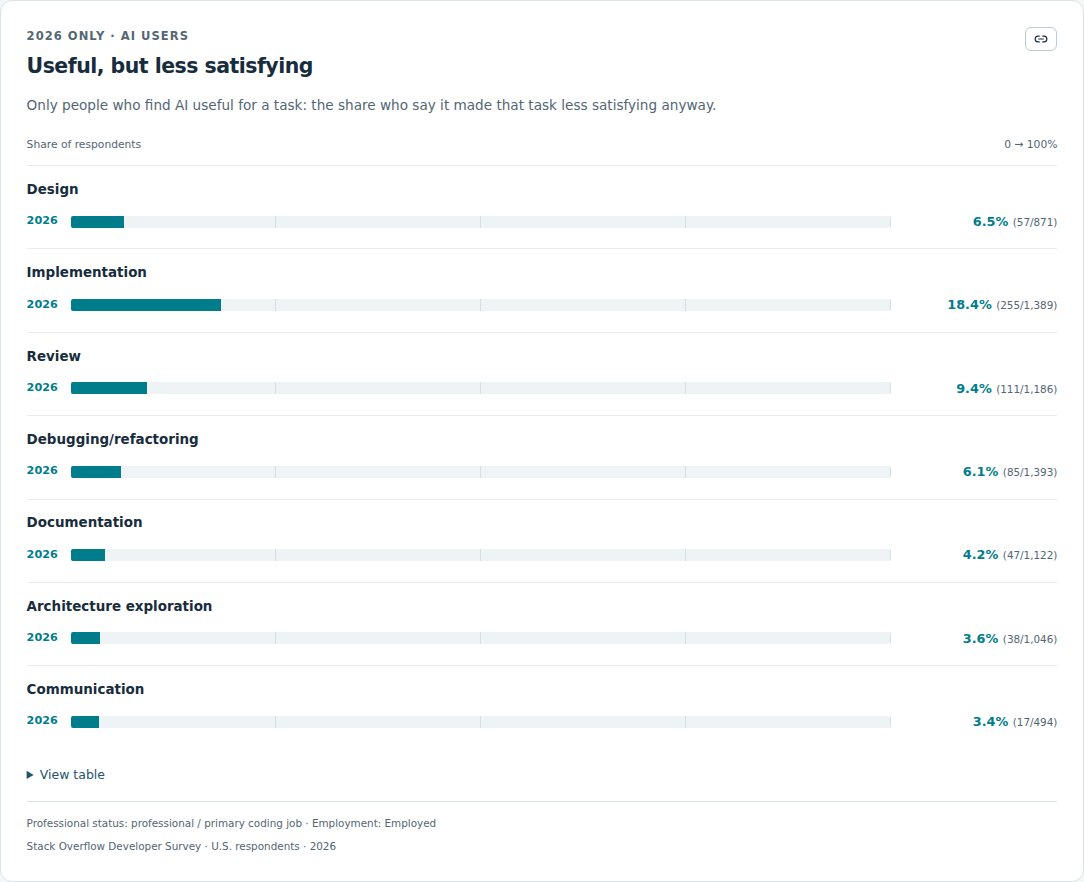
In other words, AI made debugging better for most people, but for a sizable minority it took some of the satisfaction out of implementation.
The bigger picture: AI is sorting, not lifting
Put it together and the pattern is hard to miss. Typical pay didn't move, but daily AI users pulled away. AI fans stayed fans, while more daily users came to dislike it. And where AI use is measured, twice as many developers are unhappy.
You can see the same split outside of surveys. In CircleCI's Q3 delivery report, the typical team is starting about 40% more work than at the start of the year but shipping no more of it. Only the top quarter are shipping more, and the busiest 5% now ship about 10x as often as the typical team, up from 9x in the spring.
At the very top, companies like Anthropic and Vercel already let agents approve and merge low-risk pull requests.
As an Anthropic engineer put it at a tech event, borrowing William Gibson's line: the future is already here, it's just not evenly distributed.
AI went mainstream in a year. What it didn't do is lift everyone equally...
What to watch in 2027
- Does the share of developers who don't use AI keep shrinking? 24% → 16% → ?
- Does the pay ladder get steeper, or does everyone else catch up?
- Does measuring AI use in performance reviews spread, or fade?
- Do more of the developers who use AI every day come to dislike it? 5% → 17% → ?
Filters are saved in the URL, so share any slice that changes the story.
Data notes
- Data: the official 2025 and 2026 public CSVs, restricted to U.S. residents. Salaries use Stack Overflow's USD conversion, between $10k and $2m, not adjusted for inflation.
- Who's included: employed respondents who are professional developers (2025) or create code as a primary part of their job (2026). The wording is close but not identical.
- Different people each year: these are voluntary surveys, recruited mostly through Stack Overflow. A group's median can change because the people in it changed, not because anyone's pay did.
- AI-only questions: in 2026, only AI users were asked about sentiment, complex tasks, and individual tasks, so those comparisons use AI users in both years.
- Job satisfaction is a 0–10 rating. I use Stack Overflow's own bands: 0–6 is unhappy, 7–8 complacent, and 9–10 happy. 2026 asks about your "professional role" instead of your "professional developer role".
- Changed wording: 2026 says "somewhat favorable/unfavorable" where 2025 said "favorable/unfavorable". AI use frequency went from one question about AI in development to four kinds of AI tool at work (including chat); I use the most frequent.
- Agents: 2026 counts coding agents together with coding assistants, and asks separately about "AI agents or automated workflows". The $190k figure uses the second.
- Pay comparisons use medians, because a few very high salaries make averages noisy. The "like for like" comparisons come from regressions that hold things like experience, role, company size, and industry constant. All of these are associations, not causes.
- Other sources: CircleCI's report is platform data from its own customers, and Atlassian's is a separate survey. Neither is limited to U.S. developers. The company memos are internal; the links go to the outlets that first reported them. The Anthropic details come from its own engineering write-up, and the Vercel ones from one of its engineers.
Data attribution: Stack Overflow Developer Survey, Stack Exchange Inc. Data under ODbL 1.0; individual contents under DbCL 1.0. The dashboard and these interpretations are independent of Stack Overflow.